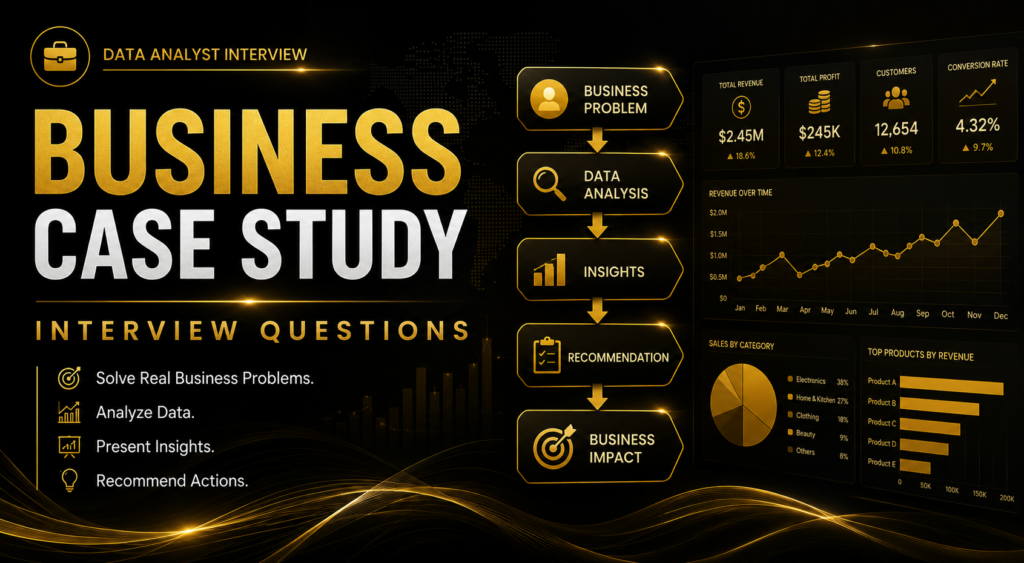
What Makes This Guide Different?
Learn how employers evaluate your ability to solve real business case studies, analyze data, identify insights, recommend actions, and present your thinking clearly during Data Analyst interviews.
Real Business Cases
Practice case study questions based on real business problems commonly asked in Data Analyst interviews.
Structured Problem Solving
Learn how to clarify the business problem, explore the data, ask the right questions, and build a logical analysis plan.
Insight & Recommendation
Go beyond analysis by explaining what the data reveals and recommending practical actions supported by evidence.
Interview-Ready Communication
Develop the confidence to explain your case study approach clearly to hiring managers, stakeholders, and interview panels.
Business Case Study Roadmap for Data Analyst Interviews
Master the case study approach employers expect in Data Analyst interviews. Learn how to understand business problems, analyze data, generate insights, recommend actions, and present your solution with confidence.
Understand the Problem
- Clarify the business objective
- Identify stakeholders
- Define success metrics
- Ask smart questions
Explore the Data
- Review available datasets
- Check data quality
- Understand key variables
- Identify missing information
Analyze the Case
- Perform SQL or Python analysis
- Compare trends and segments
- Find root causes
- Validate assumptions
Build Insights
- Summarize key findings
- Explain business impact
- Identify opportunities
- Connect data to decisions
Recommend Actions
- Prioritize solutions
- Estimate impact
- Consider risks
- Define next steps
Interview Practice
- End-to-end case studies
- Executive summaries
- Follow-up questions
- Presentation practice
Business Case Study Interview Readiness Checklist
Before practicing case study questions, make sure you're confident with the structured problem-solving skills employers commonly assess during Data Analyst interviews.
Follow the Business Case Study roadmap above before attempting advanced case study interview questions and end-to-end business scenarios.
How Employers Evaluate Business Case Study Skills
Interviewers don't just evaluate your technical skills. They assess how you approach unfamiliar business problems, analyze data, generate insights, recommend solutions, and communicate your reasoning with confidence.
Problem Solving
Employers expect you to understand the business problem, ask clarifying questions, identify objectives, and develop a structured approach before analyzing the data.
Analytical Thinking
Explore the data systematically, identify trends, investigate root causes, validate assumptions, and support your conclusions with evidence instead of making guesses.
Business Decision Making
Transform your analysis into practical business recommendations by evaluating opportunities, risks, expected impact, and measurable outcomes.
Executive Communication
Present your findings using clear business language, explain your reasoning confidently, and communicate recommendations that stakeholders can understand and act upon.
Declining Revenue at an E-commerce Company
Practice how to approach a real Data Analyst case study interview by understanding the business problem, identifying KPIs, analyzing root causes, and recommending actions.
Interview Question
An e-commerce company has experienced an 18% decline in monthly revenue over the past three months. The CEO wants to understand why revenue is falling and asks you to investigate before the next leadership meeting.
Available Datasets
- Sales Transactions
- Customer Information
- Website Analytics
- Marketing Campaign Performance
- Product Catalog
How would you approach this case study?
Understand the Business Problem
Clarify whether the revenue decline is happening across all products, regions, customer segments, or only specific areas.
Identify the Right KPIs
Review revenue, number of orders, average order value, conversion rate, customer retention, website traffic, and cart abandonment rate.
Explore the Data
Check data quality, review monthly trends, compare product categories, analyze regions, and segment new versus returning customers.
Identify the Root Cause
Investigate whether traffic, conversion rate, cart abandonment, product performance, or marketing channels are driving the decline.
Recommend Business Actions
Suggest practical actions such as improving checkout experience, optimizing campaigns, adjusting pricing, or launching retention programs.
Present to Leadership
Summarize the problem, key findings, recommendations, and success metrics in simple business language.
Interviewer's Tip
Strong candidates don't jump directly into SQL or Python. They first clarify the business objective, ask thoughtful questions, define KPIs, and then analyze the data systematically.
Customer Churn Increased After a Pricing Change
Practice how to investigate customer churn using business thinking, KPI analysis, customer segmentation, and data-driven recommendations.
Interview Question
A subscription-based company recently increased its monthly pricing. Over the next quarter, customer churn increased from 8% to 14%. The leadership team wants to know whether the pricing change caused the churn increase and what actions should be taken.
Available Datasets
- Customer Subscription History
- Pricing Plan Information
- Churn and Cancellation Records
- Customer Support Tickets
- Usage and Engagement Data
How would you approach this case study?
Clarify the Business Problem
Confirm whether the goal is to measure the impact of pricing, identify churn drivers, or recommend retention strategies.
Identify Key KPIs
Review churn rate, retention rate, monthly recurring revenue, customer lifetime value, plan upgrades, downgrades, and cancellation reasons.
Segment Customers
Compare churn by pricing plan, customer tenure, usage level, geography, customer type, and support ticket history.
Analyze Before and After
Compare churn trends before and after the price increase to identify whether churn changed significantly after the pricing update.
Identify Root Causes
Investigate whether churn was driven by pricing, low product usage, poor customer experience, support issues, or lack of perceived value.
Recommend Retention Actions
Suggest targeted retention offers, improved onboarding, loyalty discounts, better communication, or plan adjustments for at-risk customer segments.
Interviewer's Tip
Strong candidates don't immediately blame the pricing change. They compare customer segments, review before-and-after trends, investigate usage behavior, and support every recommendation with evidence.
Marketing Spend Increased, But Conversions Stayed Flat
Practice how to evaluate marketing performance using funnel analysis, campaign KPIs, customer behavior, and data-driven recommendations.
Interview Question
A company increased its marketing budget by 40% over the last two months, but website conversions have remained almost the same. The marketing director wants to understand why higher spending did not lead to more customers.
Available Datasets
- Marketing Campaign Performance
- Website Traffic Analytics
- Lead Generation Data
- Conversion Funnel Data
- Customer Acquisition Cost Data
How would you approach this case study?
Clarify the Business Goal
Confirm whether the goal is to increase leads, improve conversion rate, reduce customer acquisition cost, or identify underperforming channels.
Review Marketing KPIs
Analyze ad spend, impressions, clicks, click-through rate, conversion rate, cost per lead, cost per acquisition, and return on ad spend.
Compare Channels
Segment performance by campaign, channel, audience, device, geography, and landing page to identify where spend increased without results.
Analyze the Funnel
Check whether users are dropping off after clicking ads, visiting landing pages, starting forms, or reaching checkout.
Find Root Causes
Investigate possible issues such as poor traffic quality, weak landing pages, wrong audience targeting, slow website speed, or unclear offers.
Recommend Actions
Suggest reallocating budget to high-performing channels, improving landing pages, refining audience targeting, and testing new campaign messages.
Interviewer's Tip
Strong candidates don't assume more marketing spend should automatically increase conversions. They analyze the full funnel, compare campaign performance, and identify where users are dropping off before recommending actions.
Inventory Increased, But Stock-Outs Are Still Happening
Practice how to investigate inventory and supply chain problems using demand patterns, product performance, stock availability, and operational KPIs.
Interview Question
A retail company increased inventory levels by 30%, but customers are still seeing frequent stock-outs for popular products. Customer complaints have also increased, and leadership wants to understand why higher inventory is not improving product availability.
Available Datasets
- Inventory Levels
- Product Sales History
- Stock-Out Records
- Supplier Delivery Data
- Customer Complaints
How would you approach this case study?
Clarify the Problem
Confirm whether stock-outs are happening across all products or only specific categories, locations, suppliers, or time periods.
Review Inventory KPIs
Analyze stock-out rate, inventory turnover, reorder levels, days of inventory, demand variability, and supplier lead time.
Segment Products
Compare fast-moving products, slow-moving products, seasonal items, high-margin products, and frequently unavailable items.
Analyze Demand vs Supply
Check whether inventory is increasing in the right products and locations or simply adding excess stock to low-demand items.
Find Root Causes
Investigate supplier delays, inaccurate forecasting, poor replenishment rules, regional demand mismatch, or inventory allocation issues.
Recommend Actions
Suggest improving demand forecasting, adjusting reorder points, prioritizing high-demand products, and monitoring supplier performance.
Interviewer's Tip
Strong candidates don't assume that more inventory automatically solves stock-outs. They analyze whether the right products are available in the right locations at the right time.
New Customers Are Increasing, But Repeat Purchases Are Declining
Practice how to analyze customer segmentation, repeat purchase behavior, retention issues, and customer lifetime value using business case study thinking.
Interview Question
An e-commerce company has acquired 25% more new customers this quarter, but repeat purchases have declined by 15%. Leadership wants to know why customers are not coming back after their first purchase.
Available Datasets
- Customer Purchase History
- Customer Segmentation Data
- Marketing Campaign Data
- Product Return Records
- Customer Feedback and Reviews
How would you approach this case study?
Clarify the Business Goal
Confirm whether the focus is improving repeat purchase rate, retention, customer lifetime value, or identifying low-quality customer acquisition.
Review Customer KPIs
Analyze repeat purchase rate, retention rate, customer lifetime value, average order value, purchase frequency, and return rate.
Segment Customers
Compare new versus returning customers, high-value customers, discount-driven buyers, product categories, and acquisition channels.
Analyze Purchase Behavior
Review first purchase products, time between purchases, abandoned repeat journeys, returns, complaints, and customer feedback trends.
Identify Root Causes
Investigate whether repeat purchases are declining due to poor product experience, weak onboarding, pricing, delivery issues, or irrelevant follow-up campaigns.
Recommend Retention Actions
Suggest loyalty offers, personalized follow-up campaigns, product recommendations, improved customer experience, and retention-focused messaging.
Interviewer's Tip
Strong candidates don't celebrate new customer growth without checking retention. Employers want to see whether you can connect acquisition quality, repeat purchase behavior, and long-term customer value.
FAQ
What are Business Case Study interview questions?
Business Case Study interview questions present real-world business problems that require candidates to think analytically and recommend data-driven solutions. Instead of testing only technical skills, employers evaluate how you understand business objectives, analyze data, identify root causes, and communicate actionable recommendations.
How should I approach a Business Case Study interview?
A structured approach helps you solve case studies confidently:
- Understand the business problem.
- Ask clarifying questions.
- Identify the most important KPIs.
- Explore and analyze the available data.
- Identify root causes using evidence.
- Recommend practical business actions.
- Present your findings clearly to stakeholders.
Interviewers often evaluate your thought process as much as your final answer.
What skills do employers evaluate during Business Case Study interviews?
Employers typically assess your ability to:
- Understand business objectives.
- Think analytically and solve problems.
- Interpret data and identify trends.
- Recommend practical, data-driven solutions.
- Communicate your reasoning clearly to technical and non-technical stakeholders.
Strong candidates combine technical knowledge with business thinking.
Do Business Case Study interviews require SQL and Python?
Not always. Some interviews focus on your analytical thinking rather than coding. However, many Data Analyst case studies involve using SQL to retrieve data and Python to perform analysis, visualization, or data preparation before presenting business insights.
How can I improve my Business Case Study interview performance?
Practice solving real business scenarios instead of memorizing answers. Focus on asking the right questions, selecting relevant KPIs, supporting your conclusions with evidence, and presenting clear recommendations. The more you practice complete case studies, the more confident you’ll become in Data Analyst interviews.