What Makes This Guide Different?
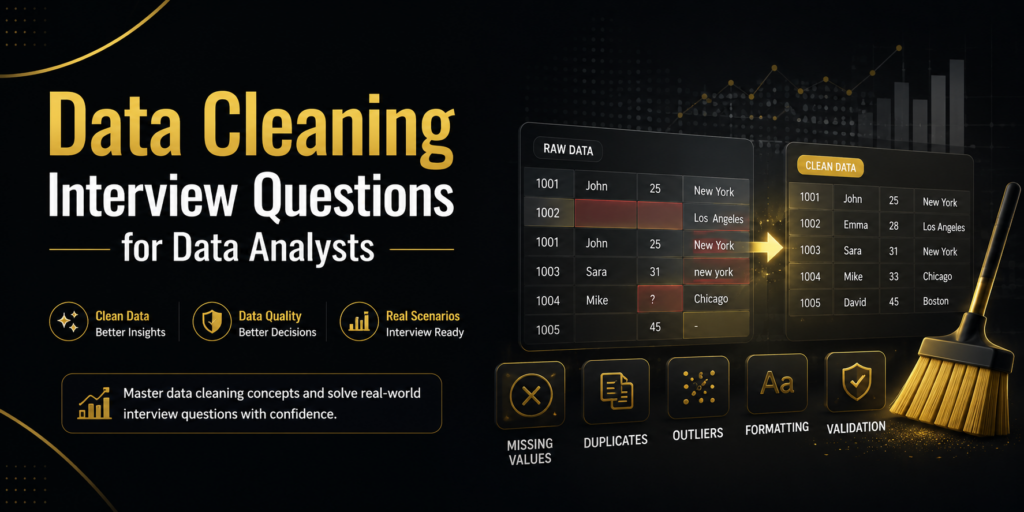
Learn how employers evaluate your ability to clean messy datasets, handle missing values, remove duplicates, detect outliers, and prepare reliable data for analysis.
Real Interview Questions
Practice data cleaning questions commonly asked during Data Analyst interviews.
Messy Data Scenarios
Learn how to handle missing values, duplicates, inconsistent formats, and outliers.
Data Quality Thinking
Understand how clean data improves accuracy, reporting, dashboards, and business decisions.
Career-Focused Learning
Build practical data cleaning skills employers expect from job-ready Data Analysts.
Data Cleaning Roadmap for Data Analyst Interviews
Master the data cleaning concepts employers expect in Data Analyst interviews. Focus on preparing messy datasets, handling missing values, fixing inconsistencies, and ensuring data quality before analysis.
Missing Values
- Identify missing data
- Drop vs impute
- Mean, median, mode imputation
- Business impact of missing values
Duplicate Records
- Detect duplicates
- Remove repeated rows
- Handle duplicate IDs
- Validate unique records
Outlier Detection
- Identify unusual values
- IQR method
- Boxplot interpretation
- Decide whether to keep or remove
Data Formatting
- Fix date formats
- Standardize text values
- Convert data types
- Clean column names
Data Validation
- Check invalid values
- Verify ranges
- Cross-check totals
- Confirm business rules
Interview Practice
- Scenario questions
- Messy dataset examples
- Explain cleaning decisions
- Communicate data quality issues
Data Cleaning Interview Readiness Checklist
Before practicing interview questions, make sure you're comfortable with the data cleaning concepts employers commonly evaluate during Data Analyst interviews.
Follow the roadmap above before attempting advanced data cleaning interview questions.
How Employers Evaluate Data Cleaning Skills
Interviewers don't just test your ability to clean data. They evaluate how you identify data quality issues, choose appropriate cleaning techniques, validate your results, and prepare reliable datasets for business analysis.
Data Quality Assessment
Identify missing values, duplicate records, inconsistent formats, invalid entries, and other data quality issues before analysis begins.
Cleaning Strategy
Explain why you remove, replace, standardize, or retain data instead of applying cleaning techniques without justification.
Data Validation
Verify that the cleaned dataset is accurate, complete, consistent, and ready for reporting, dashboards, and machine learning.
Business Thinking
Understand how poor data quality affects KPIs, customer insights, reporting accuracy, and business decision-making.
Sample Data Cleaning Interview Questions
Practice a selection of Data Cleaning interview questions commonly asked in Data Analyst interviews. Expand each question to test your understanding of missing values, duplicates, outliers, data quality, and cleaning strategies before revealing the sample answer.
🧹 Missing Values Interview Questions
I would first understand why the values are missing and determine how important the column is to the analysis. If the column is critical, I would consider an appropriate imputation technique such as the mean, median, or mode depending on the data. If the missing values are excessive and the column provides little value, I might remove it after evaluating its business impact.
I would remove rows when only a small percentage of observations are missing and deleting them is unlikely to affect the overall analysis. If removing rows would introduce bias or significantly reduce the dataset, I would prefer an appropriate imputation method instead.
The median is less affected by extreme values or outliers. When numerical data is skewed, using the median usually provides a better representation of the typical value than the mean.
Missing values can reduce model accuracy, introduce bias, and produce unreliable reports. If not handled correctly, they may lead to incorrect business conclusions and poor decision-making.
Common functions include:
isnull()
isna()
sum()
dropna()
fillna()
These functions help identify, remove, or replace missing values during data cleaning.
Key Takeaway: Employers evaluate your reasoning more than your tools. Explain why you selected a particular method for handling missing values and how it improves data quality and business decision-making.
Duplicate Data Interview Questions
I would first check whether complete duplicate rows exist using duplicated records. Then I would check key columns such as customer ID, email, phone number, order ID, or transaction ID because duplicates are not always identical across every column.
No, duplicate rows should not always be removed immediately. Some duplicates may be valid, such as repeat purchases or multiple transactions from the same customer. I would first understand the business context before deciding whether the duplicate is an error or a valid record.
Duplicate customer records can lead to incorrect customer counts, inaccurate sales reports, wrong churn calculations, duplicate marketing emails, and poor customer experience. They can also affect dashboards and business decisions.
I would group the data by customer ID and check whether fields like name, email, phone number, address, or date of birth have multiple different values. This helps identify cases where the same ID is linked to conflicting customer details.
df.duplicated()
df.drop_duplicates()
df[df.duplicated()]
df.duplicated(subset=["customer_id"])
df.drop_duplicates(subset=["customer_id"])
Your customer database contains duplicate records.
A retail company discovers that thousands of customers appear multiple times in its CRM. Some records share the same email address but have different phone numbers, while others have identical names with different customer IDs. Marketing reports and customer counts are now inconsistent.
How would you investigate and resolve this issue?
- Identify duplicate records using business keys such as email, phone number, or customer ID.
- Determine whether duplicates represent valid repeat customers or data entry errors.
- Compare conflicting information to identify the most accurate record.
- Merge or remove duplicate records based on defined business rules.
- Validate the cleaned dataset to ensure customer counts and reports are accurate.
- Recommend processes to prevent duplicate records from being created in the future.
Outlier Detection Interview Questions
An outlier is a data point that is significantly different from the rest of the dataset. Outliers can distort statistical measures such as the mean, affect visualizations, reduce machine learning model accuracy, and lead to incorrect business conclusions if not investigated properly.
Common methods include:
Boxplots
Interquartile Range (IQR)
Z-score
Scatter plots
Histograms
The choice of method depends on the data distribution and business problem. For skewed data, the IQR method is often preferred.
No. Outliers should only be removed after understanding their cause. Some outliers represent data entry errors, while others reflect genuine business events such as holiday sales, premium customers, or large corporate purchases. Removing valid outliers may eliminate valuable business insights.
I would first verify whether the spike is accurate by checking the data source and looking for duplicate or incorrect records. If the data is valid, I would investigate possible business reasons such as promotional campaigns, seasonal events, product launches, holidays, or bulk customer purchases before deciding whether it should be treated as an outlier.
It is important to be transparent about limitations in the data.
I would explain:
Missing or incomplete data.
Small sample sizes.
Assumptions made during analysis.
Potential sources of error.
Confidence in the conclusions.
Being honest about uncertainty builds trust and helps stakeholders make informed decisions.
✅ Key Takeaway: Confidence comes from transparency, not from pretending the data is perfect.
Outliers can significantly increase or decrease the mean, making it less representative of the typical data. They may also influence regression models, clustering algorithms, and distance-based machine learning techniques, leading to less accurate predictions. In some cases, using robust statistics such as the median or transforming the data may be more appropriate than removing outliers.
An unusually large sales transaction appears in your dataset.
While analyzing sales data, you notice a single transaction worth $250,000, whereas most orders range between $100 and $800. Your manager asks whether the transaction should be removed before preparing the sales report.
How would you approach this situation?
- Verify whether the transaction is a valid business event or a data entry error.
- Review supporting information such as customer details, invoices, and order history.
- Assess how the outlier affects averages, KPIs, and business reports.
- Consult business stakeholders before removing valid observations.
- Document your decision and explain its impact on the final analysis.
Data Formatting & Standardization Interview Questions
Consistent date formatting ensures that dates are interpreted correctly during filtering, sorting, merging, and time-based analysis. Inconsistent formats such as 01/05/2025 and 2025-05-01 can lead to incorrect reports, inaccurate calculations, and errors in dashboards or machine learning models.
I would first identify all variations of the same value, then replace them with a single standardized format using business rules or a mapping table. Standardizing categorical values improves grouping, reporting accuracy, and prevents the same category from being counted multiple times.
When numbers are stored as text, mathematical operations such as sums, averages, and comparisons may produce incorrect results or fail completely. It can also prevent proper sorting, filtering, and visualization, leading to inaccurate analysis and business reports.
Standardized column names make datasets easier to read, maintain, and process. Using consistent naming conventions avoids errors in code, simplifies joins and automation, and improves collaboration among team members working on the same project.
Before creating reports, I would verify that:
Date columns are stored as Date/Datetime
Numerical fields are stored as Integer or Float
Categorical variables are stored as String or Category
Boolean fields contain only True/False values
Identifier columns (such as Customer ID or Order ID) have the correct data type
Verifying data types helps ensure calculations, visualizations, and business metrics are accurate.
Inconsistent Data Formatting
Your sales dataset comes from multiple regions. Some dates are stored as MM/DD/YYYY, others as DD-MM-YYYY, and country names appear as "USA", "U.S.", and "United States". The dashboard totals and filters are showing inconsistent results.
How would you clean and standardize the data?
- Convert all date columns into one consistent date format.
- Create a mapping table to standardize country names.
- Check numeric columns stored as text and convert them correctly.
- Standardize column names for easier analysis and reporting.
- Validate totals after cleaning to confirm the results are accurate.
- Document the cleaning rules so the process can be repeated.
Data Validation & Quality Interview Questions
After cleaning the data, I verify that the number of records is correct, missing values have been handled appropriately, duplicates are removed where necessary, data types are correct, and business metrics such as totals or averages remain accurate. I also compare the cleaned data with the original source to ensure no important information was lost.
Before sharing the dataset, I would check:
Missing values
Duplicate records
Correct data types
Invalid or inconsistent values
Data ranges (e.g., age cannot be negative)
Total record count
Business metrics such as revenue or customer counts
Consistency with source data
These checks help ensure the data is accurate and reliable for decision-making.
I compare the data against expected business rules and logical constraints. For example, negative sales amounts, ages greater than 120 years, future birth dates, or impossible percentages above 100% may indicate invalid values. I also use summary statistics, filters, and validation rules to detect anomalies.
Data cleaning focuses on correcting issues such as missing values, duplicates, formatting inconsistencies, and incorrect data types. Data validation is the process of confirming that the cleaned data is accurate, complete, and meets business rules before it is used for reporting or analysis. In simple terms, cleaning fixes the data, while validation confirms the fixes were successful.
I would compare key statistics before and after cleaning, verify record counts, review summary reports, validate important business metrics, and perform spot checks on sample records. Whenever possible, I would also document each cleaning step so the process is transparent, reproducible, and easy to audit.
How Interviewers Evaluate Data Validation Skills
✅ Verify Before You Report
Explain how you confirm that the cleaned dataset is complete, accurate, and ready for analysis before sharing it with stakeholders.
📊 Check Business Metrics
Validate record counts, totals, averages, and KPIs to ensure your cleaning process hasn't changed important business results.
⚠ Follow Business Rules
Identify impossible values, inconsistent records, and formatting issues by applying logical business rules instead of relying only on automated tools.
💼 Build Trust in the Data
Employers want analysts who deliver reliable data. Explain how your validation process helps decision-makers trust reports, dashboards, and business insights.
Real Data Cleaning Scenario Questions
I would first identify all date formats used across the datasets and convert them into a single standard format, such as YYYY-MM-DD. After standardizing the dates, I would verify that no records were incorrectly converted and confirm that all branches can be combined without affecting time-based analysis or reporting.
I would compare other customer information such as email address, purchase history, account creation date, and recent activity. If the records represent the same customer, I would retain the most complete and up-to-date information or merge the records according to business rules rather than deleting data immediately.
Before making any changes, I would determine whether the negative values are valid business transactions, such as refunds or returns, or simply data entry errors. I would review transaction types, source systems, and business rules before deciding whether to correct, remove, or retain the records.
No. I would first investigate the cause of each outlier. Some outliers may represent genuine business events, such as large enterprise orders, seasonal promotions, or bulk purchases. Removing valid observations could lead to inaccurate analysis and poor business decisions, so I would explain the impact before making any changes
I would compare the source data used by both reports and check for differences in date filters, duplicate records, missing values, joins, calculations, and aggregation methods. I would also verify that both reports use the same business definitions for metrics such as revenue, profit, or customer count before identifying the root cause of the discrepancy.
What Separates Strong Data Analysts from Average Candidates?
- Strong candidates investigate data quality issues before applying cleaning techniques.
- They explain why they chose a particular cleaning method, not just how they performed it.
- They validate the cleaned dataset before using it for reports, dashboards, or machine learning.
- They understand the business impact of missing values, duplicates, outliers, and inconsistent data.
- They document their cleaning process to ensure it is accurate, reproducible, and easy for others to understand.
Ready to Move Beyond Free Interview Resources?
Learning individual topics is a great start, but employers evaluate much more than Python. Compare the free interview resources with our complete Data Analyst Interview Preparation Program designed to help you become interview-ready.
Free Interview Resources
- Free Interview Questions
- Sample Answers
- Topic-Based Learning Guides
- Interview Tips & Best Practices
- Learning Roadmaps
- Interview Readiness Checklists
- Role-Based Interview Preparation
- Real Business Scenarios
- Take-Home Assignments
- Mock Technical Interviews
- Personalized Mentor Feedback
Complete Data Analyst Interview Preparation Program
- Structured Interview Preparation Roadmap
- SQL, Python, Statistics & Power BI
- Business Metrics & KPI Interview Questions
- Data Cleaning & EDA Practice
- Real Business Scenarios & Case Studies
- Take-Home Assignments
- Portfolio Presentation Guidance
- Mock Technical Interviews
- Resume & LinkedIn Review
- Personalized Mentor Feedback
Designed for aspiring Data Analysts who want to build technical confidence, present projects effectively, and perform successfully in real interviews.
Common Data Cleaning Interview Mistakes
Many candidates know how to use data cleaning tools, but struggle to explain their decisions. Avoid these common mistakes to answer Data Cleaning interview questions with confidence.
Deleting Data Too Quickly
Don't remove missing values or duplicates without understanding why they exist and how they affect the analysis.
Removing Every Duplicate
Some duplicate records are legitimate business transactions. Always investigate before deleting them.
Ignoring Outliers
Don't assume every outlier is an error. Some unusual values represent genuine business events that provide valuable insights.
Inconsistent Data Formats
Failing to standardize dates, text values, or data types can lead to incorrect reports, joins, and calculations.
Skipping Data Validation
Always verify record counts, business metrics, and data quality after cleaning to ensure no new errors were introduced.
Ignoring Business Context
Employers expect you to explain how your cleaning decisions improve reporting accuracy and support better business decisions.
FAQ
What is Data Cleaning in a Data Analyst interview?
Data Cleaning is the process of identifying and correcting issues such as missing values, duplicate records, inconsistent formatting, incorrect data types, and invalid values before analysis. During interviews, employers evaluate your ability to prepare reliable datasets that support accurate business decisions.
Why do employers ask Data Cleaning interview questions?
Interviewers want to understand how you approach messy real-world data. They assess whether you can identify data quality issues, select appropriate cleaning techniques, validate your results, and explain the business impact of your decisions.
Which Data Cleaning topics are most commonly asked in interviews?
Common interview topics include:
- Missing Values
- Duplicate Records
- Outlier Detection
- Data Formatting & Standardization
- Data Type Conversion
- Data Validation
- Data Quality Checks
- Pandas Data Cleaning Functions
These topics frequently appear in Data Analyst technical interviews and take-home assignments.
Should I remove all missing values during an interview?
No. There is no single correct approach. Your decision depends on the amount of missing data, the importance of the column, and the business problem. Employers expect you to justify whether you remove, replace, or retain missing values rather than applying one method to every dataset.
What Pandas functions should I know for Data Cleaning interviews?
Some of the most commonly used Pandas functions include:
isnull()fillna()dropna()duplicated()drop_duplicates()replace()astype()
Interviewers are more interested in why you use these functions than simply memorizing their syntax.
How can I improve my Data Cleaning interview skills?
Practice working with messy datasets, explain your cleaning decisions step by step, and understand how poor data quality affects business reports and KPIs. Building small projects with real datasets is also an excellent way to prepare.
You may also find our Python Interview Questions, Statistics Interview Questions, and EDA Interview Questions guides helpful for strengthening your interview preparation.
Are Data Cleaning questions asked in entry-level Data Analyst interviews?
Yes. Entry-level interviews often include questions about handling missing values, removing duplicates, detecting outliers, standardizing data formats, and validating cleaned datasets. These are considered fundamental skills for Data Analysts.
Why is business context important when cleaning data?
Cleaning decisions should always support business objectives. For example, removing duplicate customer records without investigation may delete valid transactions, while removing genuine outliers could hide important business events. Employers expect candidates to consider both technical accuracy and business impact.
What should I study after learning Data Cleaning?
Data Cleaning is one part of becoming interview-ready. To strengthen your Data Analyst interview skills, continue practicing:
- Python Interview Questions
- SQL Interview Questions
- Exploratory Data Analysis (EDA) Interview Questions
- Statistics Interview Questions
- Data Visualization Interview Questions
- Business Metrics & KPI Interview Questions
Developing both technical and business skills will help you perform more confidently during technical interviews.