What Makes This Guide Different?
Learn Python the way employers evaluate it—through interview questions, practical coding exercises, and real-world problem-solving.
Real Interview Questions
Practice employer-inspired Python interview questions.
Coding Practice
Build confidence with practical coding exercises.
Interviewer Insights
Understand what interviewers actually evaluate.
Career-Focused Learning
Build practical Python skills for Data Analyst roles.
Python Learning Roadmap for Data Analyst Interviews
Learn only the Python fundamentals that employers commonly expect in Data Analyst interviews. Focus on the right topics first and avoid spending time on concepts that aren't essential for most entry-level and mid-level data analyst roles.
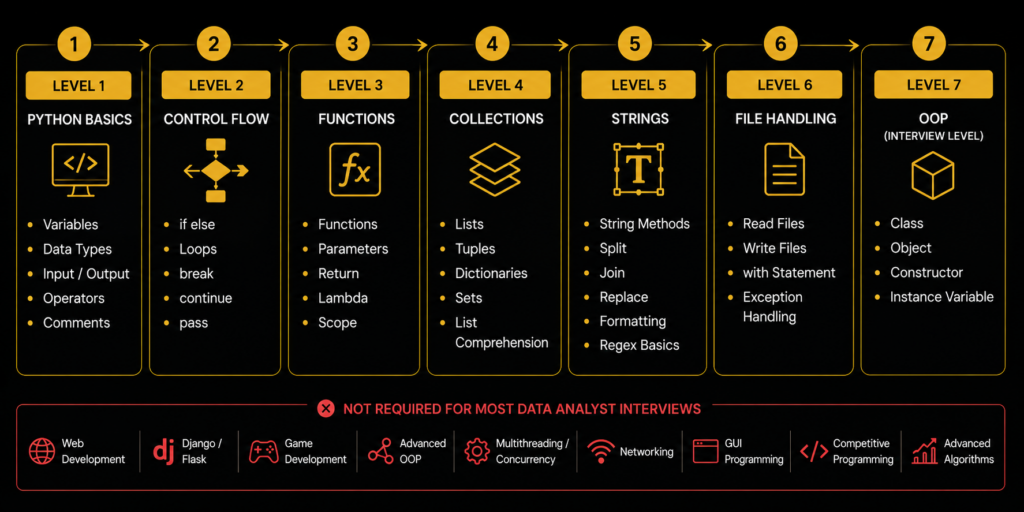
Python Interview Readiness Checklist
Before you start practicing questions, check whether you are comfortable with the core Python skills employers usually expect in Data Analyst interviews.
How Python Skills Are Evaluated in Data Analyst Interviews
Employers don’t just test Python syntax. They evaluate how you solve problems, work with data, write clean code, and explain your approach.
Data Manipulation
Clean, transform, and analyze datasets using Python and Pandas.
Problem Solving
Write efficient code, debug errors, and handle edge cases.
Data Analysis
Explore trends, summarize results, and generate useful insights.
Communication
Explain your logic clearly and connect your answer to business context.
Sample Python Interview Questions
Explore a selection of Python interview questions commonly asked in Data Analyst interviews. Expand each question to test your knowledge before revealing the sample answer.
Python Fundamentals Interview Questions
Both lists and tuples store multiple items in an ordered sequence.
List: Mutable (can be modified)
Tuple: Immutable (cannot be modified after creation)
Lists are commonly used when data changes, while tuples are preferred for fixed values.
For Example :
my_list = [1, 2, 3]
my_list.append(4)
my_tuple = (1, 2, 3)
# my_tuple.append(4) ❌ Error
== compares whether two objects have the same value.
is checks whether both variables refer to the same object in memory.
For Example:
a = [1,2]
b = [1,2]
a == b # True
a is b # False
Mutable objects can be modified after they are created.
Immutable objects cannot be changed once created.
Mutable Examples
List
Dictionary
Set
Immutable Examples
Tuple
String
Integer
Float
Note: Understanding this concept helps avoid unexpected behavior when working with variables and functions.
Python provides several built-in data types for storing different kinds of information.
Integer (int) – 10
Float (float) – 10.5
String (str) – "Python"
Boolean (bool) – True, False
List (list) – [1, 2, 3]
Tuple (tuple) – (1, 2, 3)
Dictionary (dict) – {"Name": "John"}
Set (set) – {1, 2, 3}
Both methods add elements to a list, but they behave differently.
append() adds the entire object as a single element.
extend() adds each element from another iterable individually.
numbers = [1, 2]
numbers.append([3, 4])
print(numbers)
# [1, 2, [3, 4]]
numbers = [1, 2]
numbers.extend([3, 4])
print(numbers)
# [1, 2, 3, 4]
Unpacking is the process of assigning elements from a collection to multiple variables in a single statement.
name, age, city = ("Alice", 25, "Toronto")
print(name)
print(age)
Slicing allows you to extract a portion of a sequence such as a string, list, or tuple.
General Slicing Format
sequence[start:end:step]
numbers = [10,20,30,40,50]
print(numbers[1:4])
# [20, 30, 40]
Interviewer's Advice
Strong candidates don't just define Python concepts.
- Explain where you've used them in a real project.
- Mention why you chose that approach.
- Discuss trade-offs whenever possible.
Think Like an Interviewer
If you answer confidently, the interviewer may continue with:
- When would you choose a tuple instead of a list?
- Why are tuples immutable?
- Can you share a real project example?
Control Flow
Both statements control the flow of a loop, but they behave differently.
break immediately exits the loop.
continue skips the current iteration and moves to the next iteration.
for i in range(5):
if i == 3:
break
print(i)
# Output:
# 0
# 1
# 2
for i in range(5):
if i == 3:
continue
print(i)
# Output:
# 0
# 1
# 2
# 4
The pass statement is used as a placeholder when a statement is required syntactically, but no action is needed yet.
It is commonly used while writing functions, loops, or classes that will be implemented later.
def calculate_salary():
pass
This allows the program to run without producing an error.
Both loops are used to repeat a block of code.
for loop is used when the number of iterations is known or when iterating over a sequence.
while loop is used when the number of iterations is unknown and depends on a condition.
for i in range(5):
print(i)
count = 0
while count < 5: print(count) count += 1 Choose a for loop for fixed iterations and a while loop for condition-based repetition.
One simple approach is to use a set to track seen values.
numbers = [1, 2, 3, 2, 4, 5, 3]
seen = set()
duplicates = set()
for num in numbers:
if num in seen:
duplicates.add(num)
else:
seen.add(num)
print(duplicates)
# Output:
# {2, 3}
A nested loop is a loop inside another loop. It is useful when working with two-dimensional data, comparing elements, or generating combinations.
for i in range(3):
for j in range(2):
print(i, j)
Nested loops are commonly used when processing matrices, comparing every element with another element, or generating patterns.
Strong Candidate Answer
A strong answer connects the concept to a real use case.
- Define the concept clearly.
- Give a short Python example.
- Explain when and why you would use it.
Functions
A function is a reusable block of code designed to perform a specific task. It helps make programs more organized, readable, and easier to maintain.
def greet():
print("Welcome to SAI DataScience!")
greet()
Although they are often used interchangeably, they have different meanings.
Parameter: A variable defined in the function declaration.
Argument: The actual value passed when calling the function.
def greet(name): # name is a parameter
print("Hello", name)
greet("John") # "John" is an argument
The return statement sends a value back to the caller and ends the execution of the function.
def add(a, b):
return a + b
result = add(5, 3)
print(result)
Without return, a function returns None by default.
Default arguments allow you to assign a value to a parameter. If no argument is provided when calling the function, the default value is used.
def greet(name="Student"):
print("Hello", name)
greet()
greet("Alice")
A lambda function is a small anonymous function written in a single line. It is commonly used for short operations.
lambda arguments: expression
square = lambda x: x ** 2
print(square(5))
Lambda functions are often used with functions like map(), filter(), and sorted().
A local variable is created inside a function and can only be accessed within that function.
A global variable is created outside a function and can be accessed throughout the program.
message = "Welcome"
def greet():
name = "Alice"
print(message) # Global variable
print(name) # Local variable
greet()
Mini Practice Challenge
Try solving this before checking the answer:
Collections
Each collection type serves a different purpose:
List – Ordered and mutable.
Tuple – Ordered and immutable.
Set – Unordered and stores unique values.
Dictionary – Stores data as key-value pairs.
Choose the collection based on your data and use case.
List comprehension is a concise way to create a list using a single line of code.
numbers = [x * 2 for x in range(5)]
print(numbers)
It improves code readability and is commonly used in data analysis.
Use a dictionary when data has a unique key associated with each value.
student = {
"Name": "John",
"Age": 22
}
Dictionaries provide fast lookups using keys and are widely used for structured data.
One simple method is to convert the list into a set.
numbers = [1,2,2,3,4,4]
unique = list(set(numbers))
If preserving the original order is important, use:
unique = list(dict.fromkeys(numbers))
Both methods add elements to a list.
append() adds an item to the end of the list.
insert() adds an item at a specific position.
numbers = [1,2,3]
numbers.append(4)
numbers.insert(1,100)
Common Mistakes
- Memorizing definitions without understanding practical use.
- Not giving examples from real projects.
- Ignoring edge cases and input validation.
- Writing code without explaining the approach.
Strings
You can reverse a string using slicing.
text = "Python"
print(text[::-1])
split() converts a string into a list.
join() combines a list into a single string.
text = "Python SQL Excel"
words = text.split()
sentence = " ".join(words)
Use the strip() method.
name = " Alice "
clean_name = name.strip()
Use lstrip() to remove leading spaces and rstrip() to remove trailing spaces.
Split the string into words and use the len() function.
text = "Python is easy to learn"
count = len(text.split())
print(count)
text = "I love Java"
text = text.replace("Java", "Python")
print(text)
Mini Practice Challenge
Try solving this before checking the answer:
File Handling
File handling allows Python programs to read, write, and update data stored in files. Data Analysts commonly use it to work with CSV, text, and log files.
Use the open() function.
file = open("data.txt", "r")
Common modes:
"r" Read
"w" Write
"a" Append
The with statement automatically closes the file after use, making the code safer and easier to maintain.
with open("data.txt","r") as file:
data = file.read()
Exception handling prevents a program from crashing when an error occurs.
try:
file = open("sales.csv")
except FileNotFoundError:
print("File not found.")
import pandas as pd
df = pd.read_csv("sales.csv")
Interviewer's Advice
File handling questions test practical thinking, not just syntax.
- Explain how you open, read, and close files safely.
- Mention real examples such as reading CSV, text, or log files.
- Discuss error handling when files are missing or corrupted.
Object-Oriented Programming (OOP)
Object-Oriented Programming is a programming approach that organizes code using classes and objects. It helps create reusable, organized, and maintainable programs.
A Class is a blueprint.
An Object is an instance created from that blueprint.
class Student:
pass
student1 = Student()
A constructor is a special method called __init__() that automatically runs when an object is created. It is used to initialize object attributes.
class Student:
def __init__(self, name):
self.name = name
student = Student("Alice")
The self keyword refers to the current object of the class. It allows access to the object's attributes and methods.
class Student:
def __init__(self, name):
self.name = name
Strong Candidate Answer
A strong OOP answer connects classes and objects to real-world structure.
- Define the concept clearly.
- Give a simple real-world example.
- Explain how OOP improves code organization and reuse.
Real Interview Scenarios
Sample Answer
I would first investigate why the values are missing rather than immediately filling or removing them.
Calculate the percentage of missing values.
Identify whether the missing values appear randomly or follow a pattern.
If only a small percentage is missing, I may remove those rows.
If the column is important, I would consider imputing values using the median, mean, or a business-specific strategy.
Finally, I would validate that the chosen approach does not introduce bias into the analysis.
💡 Interview Tip
Always explain why you selected an imputation method instead of only naming it.
I would first identify the bottleneck before making changes.
Possible optimizations include:
Avoid unnecessary loops.
Use vectorized Pandas operations.
Filter data before processing.
Profile the code to locate slow sections.
Consider chunk processing for large datasets.
💡 Interview Tip
Interviewers are testing your problem-solving process, not whether you know every optimization technique.
I would first define what qualifies as a duplicate.
Then I would:
Identify duplicate rows.
Compare key columns such as email or phone number.
Decide which record should be retained.
Remove duplicates while preserving important information.
Validate the final dataset.
I would avoid loading the entire file into memory.
Instead I would:
Read the data in chunks.
Process each chunk individually.
Aggregate results.
Save intermediate outputs if necessary.
Consider using libraries such as Dask or PySpark if appropriate.
I would focus on communicating business value rather than technical details.
My response would include:
The key finding.
Why it matters.
Supporting evidence.
Recommended next action.
Potential business impact.
💡 Interview Tip
Great analysts don't just analyze data—they communicate actionable insights.
Challenge Yourself
Can you explain how you would approach these real interview situations?
- A CSV file contains inconsistent date formats.
- Your dashboard numbers don't match yesterday's report.
- A Python script suddenly becomes much slower after new data arrives.
- You need to merge customer data from three different sources.
- A manager asks for insights within 15 minutes before an executive meeting.
Think through your approach before looking for a solution.
Common Python Mistakes Candidates Make in Interviews
Avoid these common mistakes that often cost candidates valuable marks during Python interviews.
Focus on understanding concepts rather than remembering code line by line.
Explain your thought process before writing code.
Always test your code with unexpected or invalid inputs.
Think about efficiency before writing your solution.
Stay calm and explain your thinking step by step.
Ready to Move Beyond Free Interview Resources?
Learning individual topics is a great start, but employers evaluate much more than Python. Compare the free interview resources with our complete Data Analyst Interview Preparation Program designed to help you become interview-ready.
Free Interview Resources
- Free Interview Questions
- Sample Answers
- Topic-Based Learning Guides
- Interview Tips & Best Practices
- Learning Roadmaps
- Interview Readiness Checklists
- Role-Based Interview Preparation
- Real Business Scenarios
- Take-Home Assignments
- Mock Technical Interviews
- Personalized Mentor Feedback
Complete Data Analyst Interview Preparation Program
- Structured Interview Preparation Roadmap
- SQL, Python, Statistics & Power BI
- Business Metrics & KPI Interview Questions
- Data Cleaning & EDA Practice
- Real Business Scenarios & Case Studies
- Take-Home Assignments
- Portfolio Presentation Guidance
- Mock Technical Interviews
- Resume & LinkedIn Review
- Personalized Mentor Feedback
Designed for aspiring Data Analysts who want to build technical confidence, present projects effectively, and perform successfully in real interviews.
FAQ
Is Python mandatory for a Data Analyst interview?
Python is one of the most commonly requested technical skills for Data Analyst roles. Employers often assess your ability to clean data, manipulate datasets, automate repetitive tasks, and perform exploratory data analysis using Python libraries such as Pandas and NumPy. While some entry-level positions may focus on Excel and SQL, learning Python significantly improves your career opportunities.
What Python topics are most frequently asked in interviews?
The most common Python interview topics include:
- Variables and Data Types
- Lists, Tuples, Dictionaries, and Sets
- Functions
- Loops and Conditional Statements
- String Manipulation
- File Handling
- Exception Handling
- Object-Oriented Programming (OOP)
- NumPy
- Pandas
- Scenario-Based Problem Solving
These topics form the foundation of most Data Analyst technical interviews.
Are coding questions asked during Python interviews?
Yes. Many employers include coding exercises to evaluate your problem-solving ability. These questions are usually based on strings, lists, dictionaries, loops, functions, file handling, and data manipulation using Pandas. Interviewers are often more interested in your thought process and code quality than simply getting the correct answer.
How can I prepare for a Python interview as a beginner?
Start by learning Python fundamentals before moving to data analysis libraries like Pandas and NumPy. Practice answering interview questions, solve coding challenges regularly, and work on small projects that demonstrate how you apply Python to real-world data problems. Mock interviews and scenario-based questions can also improve your confidence.
How long does it take to prepare for Python interview questions?
Preparation time depends on your experience. Beginners may require several weeks of consistent practice, while those with prior Python knowledge can often prepare more quickly by reviewing interview questions, coding exercises, and real-world scenarios. The key is regular practice rather than memorizing answers.
Do employers only ask theoretical Python questions?
No. Modern interviews usually combine theoretical questions with practical coding tasks and business scenarios. Interviewers often ask you to explain your approach, discuss trade-offs, and describe how you have used Python in previous projects or practical exercises.
Why are scenario-based Python interview questions important?
Scenario-based questions evaluate how you approach real business problems rather than testing memorized definitions. Employers use these questions to assess analytical thinking, decision-making, communication skills, and your ability to apply Python to solve practical challenges.
Is this free Python interview guide enough to prepare for interviews?
This guide provides a strong foundation by covering common interview questions, coding concepts, and practical scenarios. However, comprehensive interview preparation often includes mock interviews, advanced coding assignments, portfolio projects, company-specific practice, and personalized feedback to build confidence for real technical interviews.
Which Python libraries should every Data Analyst know?
Every Data Analyst should be comfortable with:
- Pandas for data manipulation
- NumPy for numerical computing
- Matplotlib for visualization
- Seaborn for statistical charts
Understanding when and why to use these libraries is often more important than memorizing every function.
What makes SAI DataScience's Python interview preparation different?
Our interview preparation focuses on practical learning rather than memorization. Along with Python interview questions, we emphasize coding practice, real interview scenarios, interviewer insights, common mistakes, and structured learning paths designed to help learners build confidence for Data Analyst and technical interviews.
Where can I practice more Python interview questions?
If you’re looking to go beyond sample questions, explore our complete Python Interview Accelerator. It includes 150+ curated interview questions, coding assignments, mock technical interviews, real-world scenarios, portfolio projects, AI interview practice, and personalized mentorship designed to help you prepare for Data Analyst, Data Science, and AI interviews.