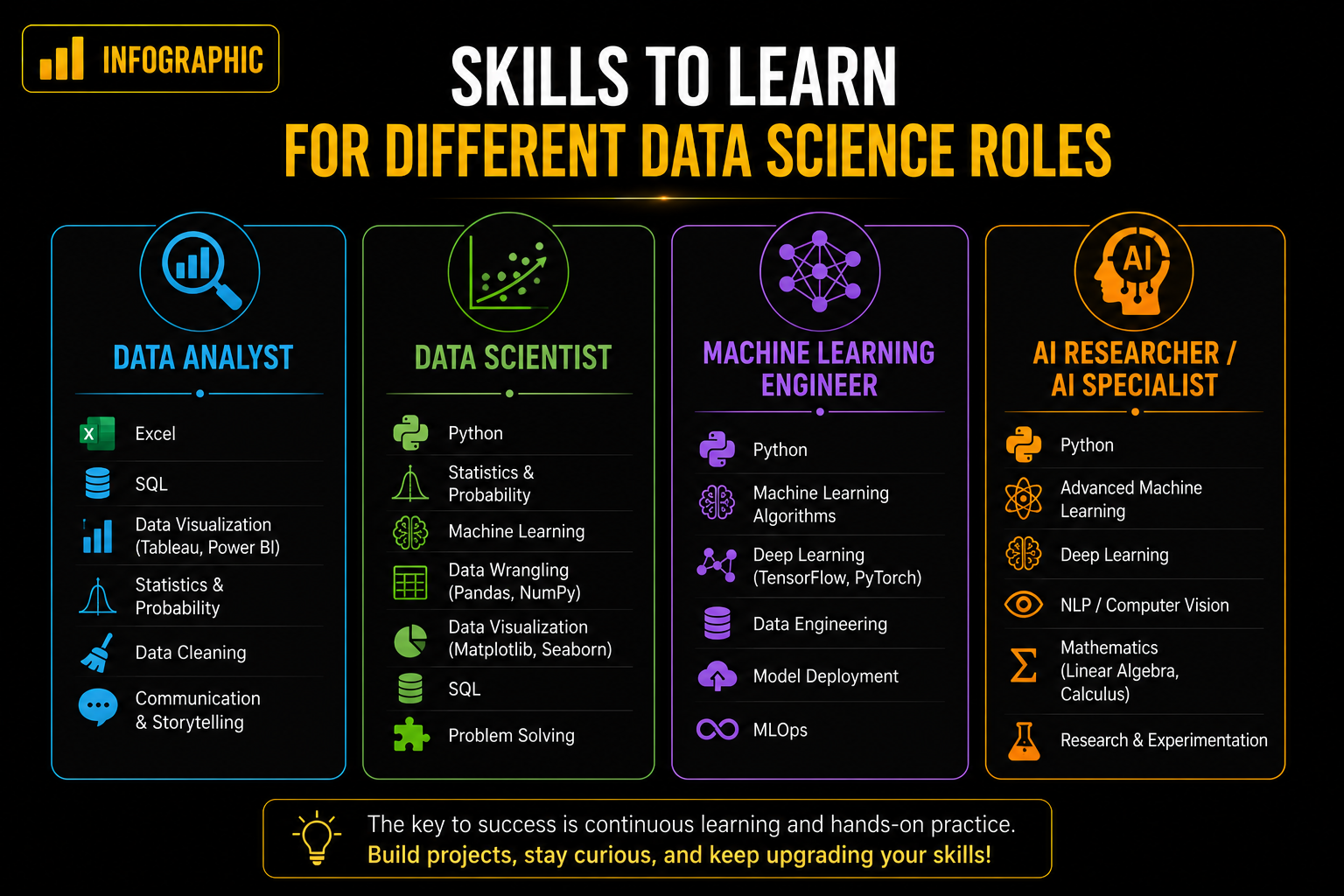
Essential Skills Required for Different Data Science Roles
Data Science has become one of the most sought-after career fields in today’s data-driven world. Organizations across industries rely on data professionals to analyze information, uncover insights, build predictive models, and support strategic decision-making.
However, “Data Science” is a broad field that includes several specialized roles, each requiring a unique combination of technical, analytical, and business skills. Whether you’re planning to become a Data Analyst, Data Scientist, Machine Learning Engineer, or Business Intelligence Analyst, understanding the required skill set can help you choose the right career path.
Let’s explore the key skills needed for some of the most popular Data Science careers.
1. Data Analyst
A Data Analyst focuses on collecting, cleaning, analyzing, and interpreting data to help organizations make informed business decisions. They transform raw data into meaningful insights through reports, dashboards, and visualizations.
Key Skills for a Data Analyst
SQL and Python
Strong knowledge of SQL is essential for querying databases and extracting data. Python helps automate tasks, clean datasets, and perform data analysis efficiently.
Data Cleaning and Preparation
Real-world data is often messy. Data Analysts must know how to handle missing values, duplicates, and inconsistencies.
Data Visualization
Creating clear and impactful dashboards using tools such as Tableau and Power BI is a critical skill for communicating insights.
Statistical Analysis
Understanding concepts such as averages, distributions, correlations, and hypothesis testing helps analysts make data-driven conclusions.
Problem-Solving Skills
Data Analysts must identify trends, patterns, and business opportunities hidden within data.
Communication Skills
The ability to explain technical findings to non-technical stakeholders is equally important as technical expertise.
2. Data Scientist
Data Scientists go beyond reporting and analysis. They build predictive models and use advanced analytics to solve complex business problems using machine learning and statistical techniques.
Key Skills for a Data Scientist
Statistical Analysis
A strong foundation in statistics is crucial for understanding data patterns and building reliable models.
Machine Learning
Knowledge of supervised and unsupervised learning algorithms such as Linear Regression, Random Forest, Clustering, and Neural Networks is essential.
Programming Skills
Python is the most widely used programming language in Data Science, while R remains popular for statistical computing.
Data Wrangling
Data Scientists spend significant time preparing, transforming, and cleaning data before model development.
SQL and Databases
The ability to extract and manage data from relational databases is an important skill.
Data Visualization and Storytelling
Communicating insights through charts, dashboards, and presentations helps drive business decisions.
Business Understanding
Successful Data Scientists understand how their models impact business objectives and outcomes.
3. Machine Learning Engineer
Machine Learning Engineers focus on designing, deploying, and maintaining machine learning systems in production environments. They bridge the gap between Data Science and Software Engineering.
Key Skills for a Machine Learning Engineer
Machine Learning and Deep Learning
A solid understanding of machine learning algorithms, neural networks, and deep learning frameworks is essential.
Programming Expertise
Strong coding skills in Python are required. Knowledge of Java or C++ can also be beneficial.
Model Deployment
Experience deploying machine learning models using APIs, Docker, cloud platforms, and MLOps tools is highly valuable.
Big Data Technologies
Familiarity with Hadoop, Spark, and distributed computing systems helps process large-scale datasets.
Software Engineering Practices
Knowledge of Git, version control, testing, and scalable architecture is important for production-ready solutions.
Cloud Platforms
Experience with AWS, Azure, or Google Cloud can significantly enhance career opportunities.
Problem-Solving and Collaboration
Machine Learning Engineers often work with Data Scientists, developers, and business teams to implement AI solutions.
4. Business Intelligence (BI) Analyst
Business Intelligence Analysts use data to monitor business performance, identify trends, and support strategic decision-making through dashboards and reporting systems.
Key Skills for a Business Intelligence Analyst
SQL and Database Management
BI Analysts frequently work with databases to retrieve and organize business data.
Data Visualization Tools
Expertise in Power BI, Tableau, or similar reporting tools is essential.
Data Warehousing Concepts
Understanding data warehouses, ETL processes, and data modeling improves reporting efficiency.
Business Acumen
BI professionals must understand business operations, key performance indicators (KPIs), and organizational goals.
Analytical Thinking
The ability to interpret data and identify actionable insights is critical.
Communication Skills
Presenting findings clearly to executives and stakeholders helps drive strategic decisions.
Which Data Science Career Path Is Right for You?
Each role within Data Science serves a different purpose:
-
Data Analyst: Focuses on reporting, dashboards, and business insights.
-
Data Scientist: Builds predictive models and advanced analytics solutions.
-
Machine Learning Engineer: Deploys and scales AI and machine learning systems.
-
Business Intelligence Analyst: Uses data to improve business performance and decision-making.
While technical skills are important, successful professionals also develop strong communication, problem-solving, and business understanding skills.
Final Thoughts
The field of Data Science continues to grow rapidly, creating exciting opportunities across industries. Whether you’re just starting your journey or looking to advance your career, building a strong foundation in data analysis, programming, statistics, and business problem-solving will set you up for long-term success.
Remember, learning Data Science is not just about mastering tools and technologies—it’s about using data to create meaningful impact and solve real-world problems.
Start with the fundamentals, build hands-on projects, and continuously expand your skills to stay competitive in this evolving field.