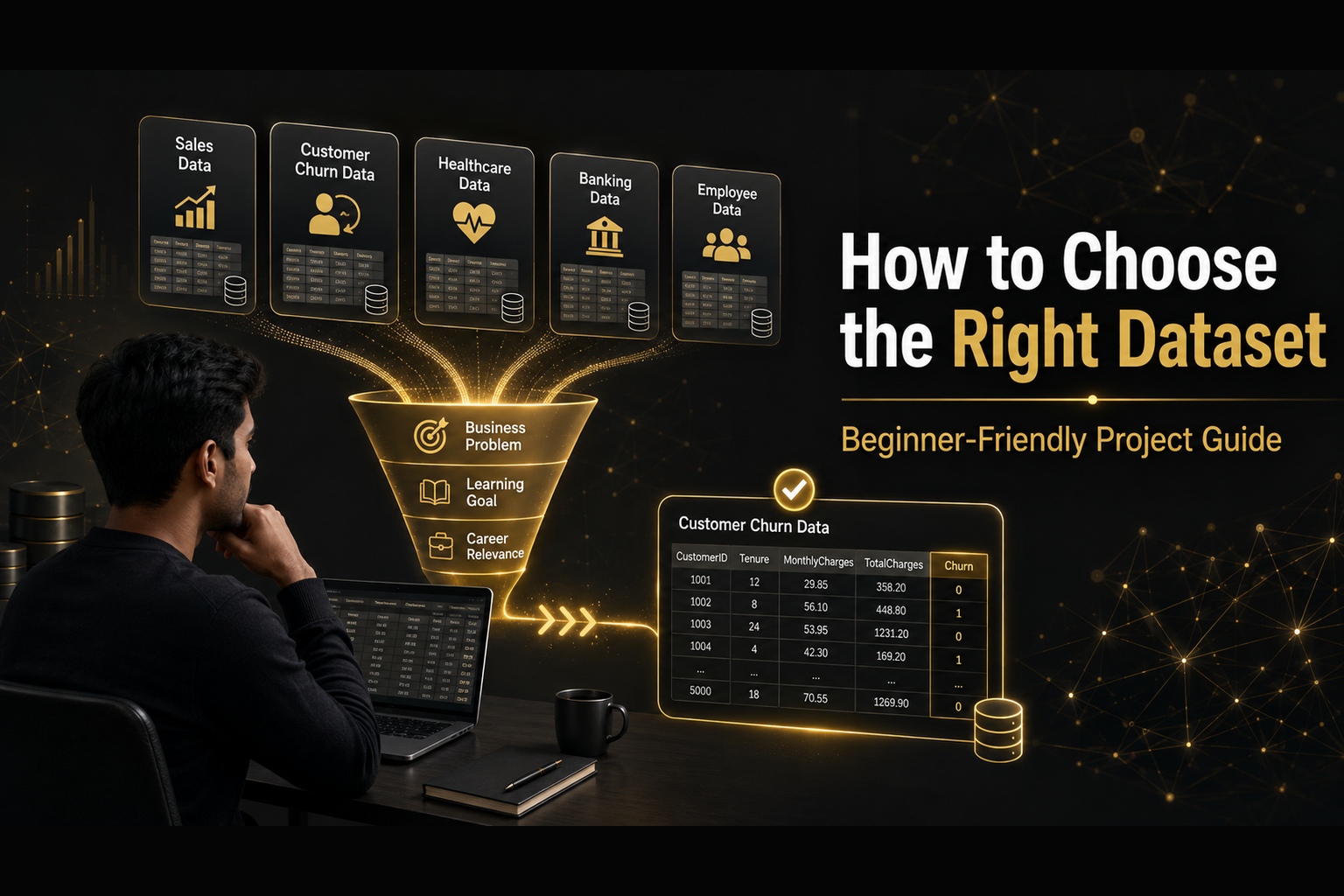
Choosing a dataset is one of the first—and most important—steps in a data project.
Many beginners select a dataset because it is popular or has thousands of records. After downloading it, they discover that they do not understand the columns, cannot define a business problem, or do not know what they are supposed to predict.
A good beginner dataset should help you practise the right skills without creating unnecessary complexity.
In this guide, you will learn practical strategies for selecting a dataset for data analysis, visualization and machine learning projects.
Choosing a dataset is one of the first—and most important—steps in a data analysis or machine learning project.
Many beginners select a dataset because it is popular or contains thousands of records. After downloading it, they discover that they do not understand the columns, cannot define a business problem, or do not know what they are supposed to predict.
A good beginner dataset should help you practise the right skills without creating unnecessary complexity.
Start With the Learning Goal
Before searching for a dataset, decide what you want to learn. Different datasets are suitable for different tasks.
| Learning Goal | What the Dataset Should Contain | Beginner Sample Dataset |
|---|---|---|
| Data cleaning | Missing values, duplicates and inconsistent categories | Breast Cancer Dataset |
| Exploratory data analysis | Numerical and categorical columns | Student Performance Dataset |
| Data visualization | Categories, dates and measurable values | Wine Quality Dataset |
| Classification | A categorical target such as Yes or No | Iris Classification Dataset |
| Regression | A continuous numerical target | Wine Quality Dataset |
| Clustering | Customer or product features without using a target | Iris Clustering Dataset |
| Time-series analysis | Records organized by date or time | Seoul Bike Demand Dataset |
Select a dataset name to open its official information and download page. Always read the dataset description and column information before beginning your analysis.
Strategy 1: Choose Based on a Business Problem
Do not begin with the algorithm. Begin with a business question. A clear question gives direction to your complete project.
Examples of Business Questions
- Which customers are likely to leave?
- What factors influence house prices?
- Which products generate the most revenue?
- Which customers may default on a loan?
- How have monthly sales changed?
- Can customers be divided into meaningful groups?
Once the problem is clear, check whether the dataset contains the information required to answer it.
Example: To analyze customer churn, you may need customer characteristics, subscription information, product usage, payment history and churn status.
Strategy 2: Choose Based on the Machine Learning Type
Classification
Use classification when the result belongs to a category.
- Customer will churn or not churn
- Loan will default or not default
- Transaction is fraudulent or legitimate
- Email is spam or not spam
Regression
Use regression when you want to predict a continuous numerical value.
- House price
- Monthly sales
- Delivery time
- Customer spending
- Insurance cost
Clustering
Use clustering when you want to discover groups but do not already have a target column.
- Group customers by spending behaviour
- Identify similar products
- Create audience segments
- Group stores based on performance
Strategy 3: Choose a Dataset Related to Your Career
A portfolio project becomes more valuable when it connects your previous experience with your target career.
| Previous Experience | Possible Project | Sample Dataset |
|---|---|---|
| Healthcare | Patient health or diagnosis analysis | Heart Disease Dataset |
| Banking | Marketing-response or customer analysis | Bank Marketing Dataset |
| Retail | Sales and customer analysis | Online Retail Dataset |
| Human resources | Employee performance or attrition analysis | IBM HR Analytics Dataset |
| Marketing | Campaign-response prediction | Bank Marketing Dataset |
| Education | Student-performance analysis | Student Performance Dataset |
| Transportation | Bike demand or rental analysis | Seoul Bike Demand Dataset |
Your previous industry knowledge can help you understand the problem, interpret findings and make practical recommendations.
Select a Manageable Dataset
A larger dataset is not always a better dataset. For a beginner project, a useful starting range is:
500–10,000
Rows
8–20
Useful Columns
CSV or Excel
Preferred Format
Beginners Should Initially Avoid
- Millions of records
- Hundreds of columns
- Multiple connected files
- Images, audio and video data
- Large unstructured text collections
- Datasets requiring advanced cloud processing
Understand What Each Row Represents
Before selecting a dataset, answer one important question:
What does one row represent?
One row might represent one customer, order, product, employee, medical appointment or financial transaction.
If you cannot explain what one row represents, you may struggle to analyze the dataset correctly.
Check the Target Column
For supervised machine learning, the dataset must have a meaningful target—the result you want to predict.
| Business Problem | Possible Target Column |
|---|---|
| Predict customer churn | Churn |
| Predict loan default | Loan_Default |
| Predict house value | House_Price |
| Predict employee attrition | Attrition |
| Predict monthly sales | Monthly_Sales |
If the dataset does not have a clear target, it may still be useful for exploratory analysis, visualization or clustering.
Choose the Right Difficulty Level
Level 1
Clean Dataset
Best for learning Pandas, visualization, basic model training and model evaluation.
Level 2
Moderately Messy
Includes some missing values, duplicates, incorrect data types and outliers. Recommended for beginner portfolio projects.
Level 3
Complex Dataset
May contain multiple files, unclear fields, severe imbalance or extensive missing data.
Inspect Data Quality
Before committing to a dataset, examine:
- Number of rows and columns
- Column names and data types
- Missing values
- Duplicate records
- Unique categories
- Possible outliers
- Target distribution
- Unnecessary identifier columns
Check the Target Balance
For a classification project, examine how many examples belong to each target class.
Example of an Imbalanced Dataset
Legitimate transactions
99%
Fraudulent transactions
1%
An imbalanced dataset may still be useful, but it requires additional modelling and evaluation techniques. For a first classification project, choose a dataset where both classes have a reasonable number of examples.
Watch for Data Leakage
Data leakage occurs when the model receives information that would not be available when making a real prediction.
Example: When predicting whether an employee will leave, a column such as
Exit_Interview_Completed may reveal that the employee has already left.
The model should only use information that would be available before the event being predicted.
Check Privacy and Ethics
Avoid publishing projects that expose private or confidential information.
- Full names
- Personal email addresses
- Phone numbers or home addresses
- Medical identifiers
- Bank account information
- Confidential company information
Use public, anonymized or synthetic datasets whenever possible.
Where Can Beginners Find Datasets?
Kaggle
Explore Datasets →
UCI Repository
Explore Datasets →
Data.gov
Explore Datasets →
Statistics Canada
Explore Data →
World Bank Open Data
Explore Data →
Canada Open Data
Explore Datasets →
Before using a dataset, check who published it, when it was updated, whether documentation is available and whether you have permission to reuse it.
Three Dataset-Selection Approaches
1. Skill-First Approach
Begin with the skill you want to practise.
“I want to practise classification, so I need a dataset with a categorical target.”
2. Problem-First Approach
Begin with a meaningful business question.
“I want to identify customers who may leave, so I need customer behaviour and churn data.”
3. Career-First Approach
Begin with your previous industry or target role.
“I have banking experience, so I will build a loan-risk or customer-segmentation project.”
For portfolio projects, combining the career-first and problem-first approaches usually produces the strongest result.
Beginner Dataset Checklist
Can I explain the business problem in one sentence?
Do I know what one row represents?
Do I understand most of the columns?
Does the dataset support my learning objective?
Is there a clear target if prediction is required?
Is the dataset manageable?
Does it contain enough records?
Are the target classes reasonably represented?
Is it free from confidential information?
Does it relate to my career or industry?
Can I explain the completed project to an employer?
Final Advice
Do not choose a dataset only because it is large, popular or already used in many tutorials.
Choose a Dataset That:
- Supports a clear business problem
- Matches your current learning level
- Contains understandable features
- Relates to your career goals
- Allows you to demonstrate practical skills
A simple dataset with a clear business story can create a stronger portfolio project than a complex dataset you cannot confidently explain.