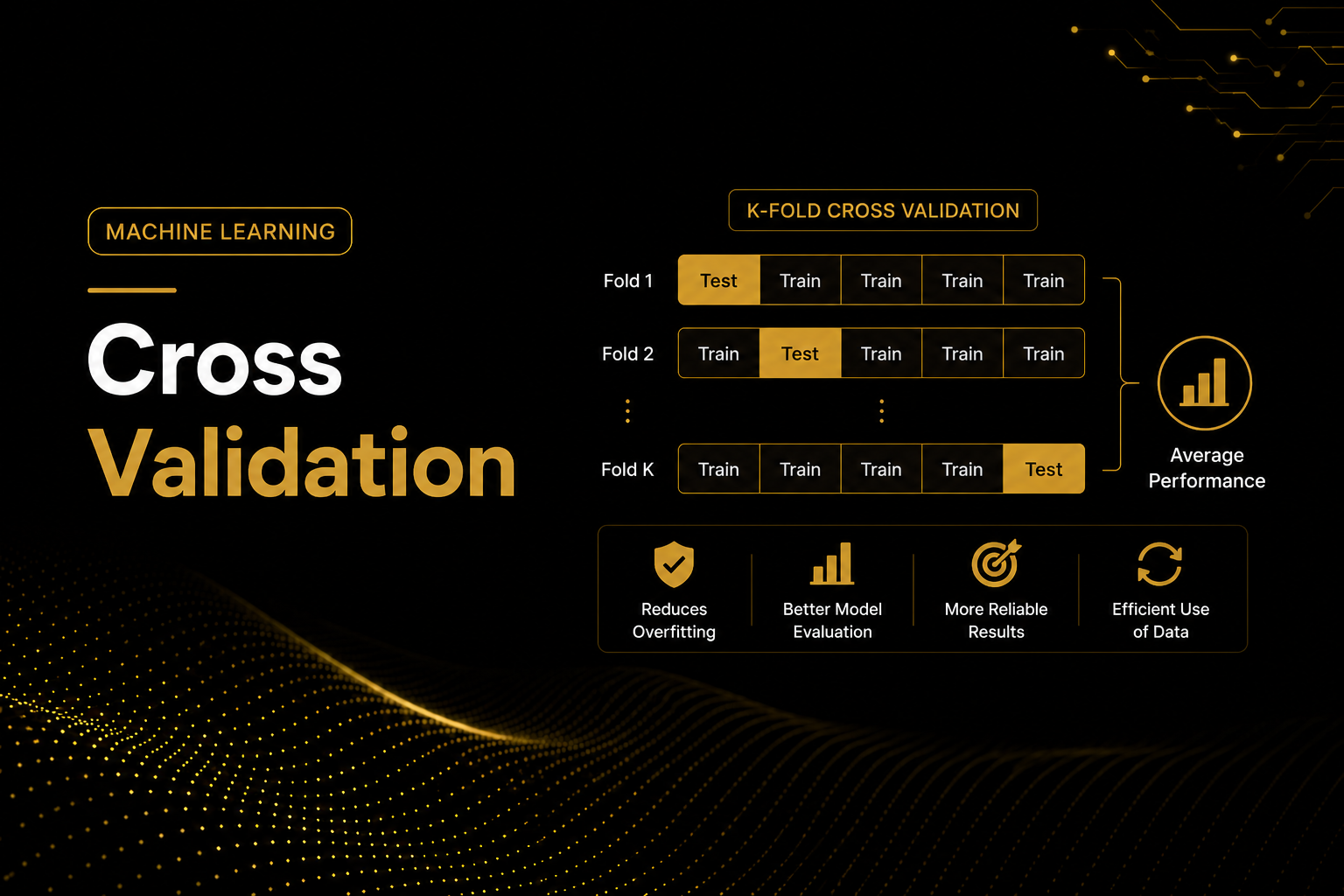
Cross validation in machine learning is one of the most important techniques used to evaluate model performance and ensure that a model generalizes well to unseen data.
What is Cross Validation in Machine Learning?
In the world of machine learning and data science, model evaluation is as crucial as model development. One of the most robust and widely-used methods for evaluating model performance is cross-validation. It helps to assess how the outcomes of a statistical analysis will generalize to an independent dataset. This article explores what cross-validation is, why it is essential, and discusses the various types of cross-validation methods commonly used in practice.
What is Cross-Validation?
Cross-validation is a statistical technique used to evaluate the performance of machine learning models. The idea is simple: split the data into multiple parts, use some of them for training and the rest for testing, and repeat this process several times to get a reliable estimate of model performance.
This method helps to reduce problems like overfitting and underfitting and provides a more accurate measure of how well a model will perform on unseen data.
Why Use Cross-Validation?
Cross-validation is essential for several reasons:
- Model Validation: Helps estimate the performance of a model on unseen data.
- Model Selection: Useful in comparing the performance of different models.
- Parameter Tuning: Supports hyperparameter optimization by providing a reliable performance estimate.
- Prevents Overfitting: By validating on different subsets of data, it ensures that the model does not simply memorize the training data.
Types of Cross Validation in Machine Learning
There are several types of cross-validation techniques, each suited to different data types and modeling scenarios. Let’s explore them in detail:
1. Hold-Out Cross-Validation
This is the simplest form of cross-validation. The dataset is divided into two parts:
- Training set
- Testing set
Typically, 70-80% of the data is used for training and the remaining 20-30% for testing.
Pros:
- Simple to implement
- Fast to execute
Cons:
- High variance due to single split
- The model might be overfitted or underfitted depending on the split
2. K-Fold Cross-Validation
In K-Fold Cross-Validation, the data is divided into K equal parts (or folds). The model is trained on K-1 folds and tested on the remaining one. This process is repeated K times, each time with a different test set. The final performance is the average of the K results.
Pros:
- More accurate performance estimate
- Every data point gets a chance to be in the test set
Cons:
- More computationally expensive
- May not be suitable for time-series data
3. Stratified K-Fold Cross-Validation
This is a variation of K-Fold cross-validation where the folds are made by preserving the percentage of samples for each class. This is particularly useful for imbalanced datasets.
Pros:
- Maintains class distribution
- Better for classification problems with imbalanced data
Cons:
- More complex to implement than simple K-Fold
4. Leave-One-Out Cross-Validation (LOOCV)
In LOOCV, each data point is used once as a test set while the remaining data points form the training set. If you have N data points, the model is trained N times.
Pros:
- Utilizes as much data as possible for training
- Provides almost unbiased estimate
Cons:
- Very high computational cost
- Can lead to high variance in performance estimates
5. Time Series Cross-Validation
For time-series data, the assumption of data being independent and identically distributed (i.i.d.) is not valid. Therefore, special cross-validation methods like Forward Chaining or Rolling Forecast are used.
Example of Forward Chaining:
- Fold 1: Train [1], Test [2]
- Fold 2: Train [1,2], Test [3]
- Fold 3: Train [1,2,3], Test [4], and so on.
Pros:
- Respects the temporal order of data
- Prevents data leakage
Cons:
- Fewer training samples in early folds
- Not suitable for non-temporal data
Conclusion
Cross-validation is a powerful technique for assessing the performance and robustness of machine learning models. By understanding the different types and their trade-offs, data scientists can make informed decisions to ensure their models generalize well to unseen data. Whether working with balanced, imbalanced, small, large, or temporal datasets, there is a cross-validation technique suited to every scenario.
When to Use Cross Validation in Machine Learning?
Mastering cross-validation not only improves model reliability but also builds a solid foundation for building production-ready AI systems.